Dariush Forouhar: Political Life, Biography and Assassination
Dariush Forouhar was an Iranian politician who served as the Minister of Labor and Social Affairs from February 1979 to October 1979. He was also the Secretary-General and founder of the Hezb-e Melli Iran (Nation of Iran Party) and was one of the leaders of the National Front of Iran from 1977 until his departure from it in early 1979. Forouhar was considered a pioneer of Pan-Iranism.
This article is based on materials from the page «Dariush Forouhar» in the Persian section of the free encyclopedia Wikipedia. The text is distributed under the CC BY-SA 4.0 license.
During the premiership of Mohammad Mosaddegh, Forouhar was the head of the Hezb-e Melli Iran. Alongside other parties, it helped form the National Front of Iran. After the 1953 coup d’état, Forouhar continued his struggle for the implementation of the constitutional monarchy and the establishment of democracy. He joined the National Resistance Movement formed by Mehdi Bazargan and others. Due to these activities, he was arrested and imprisoned for 14 years. With the onset of the 1979 Revolution, Forouhar joined the people’s struggle.
After the victory of the revolution, Forouhar served as the Minister of Labor and then as a Minister without Portfolio in Mehdi Bazargan’s Provisional Government. He later ran unsuccessfully in the 1980 Iranian presidential election. From the beginning of 1980, he joined the ranks of critics of the new Islamic Republic system. In 1981, several members of his party were executed, and he himself was also imprisoned. Forouhar was an opponent of the Islamic Republic and had called for a referendum to determine the new government in Iran. He and his wife, Parvaneh Eskandari, were killed in December 1998 during the series of political assassinations known as the Chain Murders.
Life
Dariush Forouhar was born in 1928 in Isfahan. He began his political activity at the age of 15 after becoming acquainted with Mohammad Mosaddegh and was arrested and imprisoned more than ten times before the 1979 Revolution. The experience of 15 years in prison made him a symbol of struggle, to the extent that some of his friends called prison his second home.
In December 1948, at the age of 20, Forouhar joined the “Maktab” group, which was the core of a nationalist and militant political group. Three years later, in October 1951, Maktab transformed into the Hezb-e Melli Iran, and Dariush Forouhar became a member of its provisional leadership committee. In January 1952, at the age of 23, he was elected Secretary of the party. Following political activities after the 1953 coup, a bounty was placed on his capture, dead or alive.
In 1959, while he was in prison, General Hedayat, seemingly carrying a message from the Shah, advised him to leave Iran forever. Forouhar, however, responded, “I prefer prison to freedom away from my homeland.”
In 1960, with the formation of the Second National Front, Dariush Forouhar, although in prison, was elected to the Central Council of this front. On the eve of the 1979 Iranian Revolution, he participated in the front lines of protest marches, demonstrating his desire to change the monarchical system in Iran.
Imprisonment during the Pahlavi Era
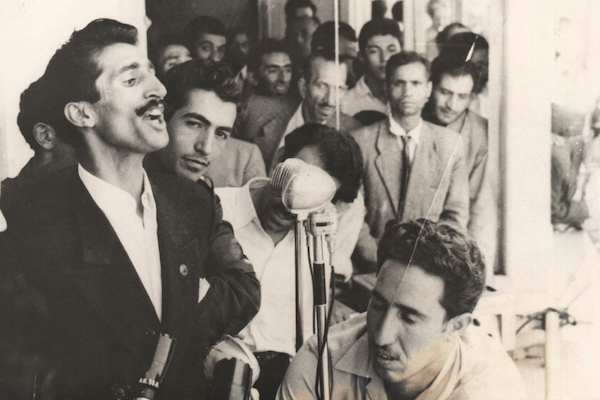
Forouhar was imprisoned multiple times for his political activities during the Pahlavi era. First, after the 1953 coup, he was imprisoned for 7 months and exiled to Fasham. Then, until 1960 and the formation of the Second National Front, he was imprisoned repeatedly. During the renewed activity of the Second National Front (1960-1965), Forouhar was imprisoned several times along with other leaders of the group.
However, Dariush Forouhar’s longest imprisonment was three years, following his protest against the disintegration of Iran and the separation of Bahrain from Iran.
Activities during the Revolution
In June 1977, three leaders of the National Front—Karim Sanjabi, Dariush Forouhar, and Shapour Bakhtiar—wrote a letter to the Shah demanding he end his autocratic rule and comply with constitutional principles to save the country.
The text of the tri-signature letter dated June 12, 1977, to the Shah stated in part: “…Therefore, the only way to return and grow faith and individual personality and national cooperation and escape the difficulties that threaten Iran’s future is to abandon autocratic rule, fully comply with constitutional principles, revive the rights of the nation, truly respect the constitution and the Universal Declaration of Human Rights, abandon the single party, freedom of the press, freedom of political prisoners and exiles, and establish a government that relies on the majority of representatives elected by the people and considers itself responsible for governing the country according to the constitution.”
Forouhar, in November 1977 after the release of Mahmoud Taleghani from prison, called on people to break the martial law decree. Consequently, a huge line of people, holding flower branches, walked from the bazaar to Taleghani’s house. Forouhar, in a speech during that march, declared that “the future system of Iran must be determined by a referendum.” He was then imprisoned again. After his release in November 1977, he became the spokesman for the National Front of Iran.
On November 19, 1977, the union of National Front forces announced its existence in a statement. With this announcement, the socialists of the National Movement of Iran, the Iran Party, and the Hezb-e Melli Iran formed the Fourth National Front.
After the Revolution
Forouhar traveled to Paris on January 16, 1979, coinciding with the Shah’s departure from Iran, to meet with Ruhollah Khomeini and returned to the country with him 16 days later. Immediately after the revolution, on February 13, 1979, he joined the Provisional Government cabinet under Prime Minister Mehdi Bazargan, first as Minister of Labor and then as a mobile minister and government representative for Kurdish affairs. In March 1979, Ruhollah Khomeini asked him to address the situation of workers. Dariush Forouhar announced the separation of himself and the Hezb-e Melli Iran from the National Front of Iran at a press conference on June 21, 1979. He ran as a candidate in the first presidential election and received 133,000 votes (0.9%), placing fourth after Abolhassan Banisadr, Ahmad Madani, and Hassan Habibi.
Imprisonment after the Revolution
Forouhar went to prison at the beginning of the autumn of 1981, adding five months of imprisonment to his political resume after the revolution. According to friends and companions of Forouhar, this five-month detention caused him to lose significant weight. Based on some reports, Forouhar was released by the direct order of Khomeini because he had been a cellmate of Mostafa Khomeini, the son of Ruhollah Khomeini, in the Shah’s prison. Apparently, accounts of his companionship in prison had reached Khomeini.
Union of Parties and National Forces of Iran
In the early 1990s, Forouhar tried to establish the “Union of Parties and National Forces of Iran” with the People’s Party of Iran, the Movement for the Freedom of the People of Iran, and others, but it was unsuccessful.
Murder
In the autumn of 1998, Parvaneh and Dariush Forouhar were murdered in their personal home on Moradzadeh Street in Tehran during the political assassinations known as the Chain Murders, by multiple stab wounds.
The killers, who had gone to their home posing as student-journalists for an “interview for a student publication,” first restrained them and then stabbed them repeatedly. Their bodies were placed facing the Qibla. Following the murder, Ali Khamenei said in a speech about him: “The late Forouhar was our friend before the revolution, our colleague at the beginning of the revolution, and after the seditions of 1981, he became our enemy; but a harmless enemy… He had no reputation among the people, no one was influenced by his words, he had no influence, he was a harmless enemy… Now, do you think someone who kills someone like Forouhar can be a friend of the system?”
Forty-five days after the incident, the Ministry of Intelligence announced: “Unfortunately, a small number of irresponsible, misguided, and rogue colleagues of this ministry, who undoubtedly became tools in the hands of hidden agents and committed these criminal acts for the interests of foreigners, exist among them.”
The accused, who were employees of the Ministry of Intelligence, in their confessions called the murder “physical elimination” that had been communicated to them by the Ministry of Intelligence and wrote that it was part of their “organizational duties” and they acted based on predetermined orders and procedures.
In a court session, Ali Safaei, an employee of the Ministry of Intelligence, described the events of that night.
This article is an adapted translation/derivative work based on the «Dariush Forouhar» entry from the Persian Wikipedia, used under the CC BY-SA 4.0 license. The original authors are credited on the page’s history. This version is also licensed under CC BY-SA 4.0.